
24/7 Support Centerinfo@sunspike.net
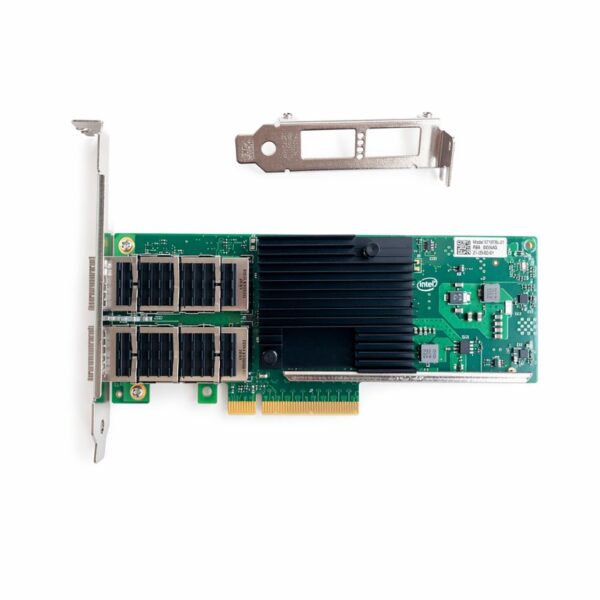
Intel XL710-QDA2 40GbE QSFP+ Dual Port PCIe Ethernet Network Adapter
Intel XL710-QDA2 40GbE QSFP+ Dual Port PCIe Ethernet Network Adapter
Enterprise stock · tested · export documentation available
Product Overview
The Intel® Ethernet Converged Network Adapter XL710-QDA2 is a dual-port 40GbE adapter that belongs to the Intel® Ethernet 700 Series. Designed for server virtualization, cloud deployment, and high-performance computing (HPC) environments, the XL710-QDA2 delivers reliable performance, low latency, and highly efficient CPU utilization.
By utilizing hardware-based virtualization offloads and standard QSFP+ ports, it addresses the demanding needs of the next-generation agile data center by supporting both 40GbE speed configurations and breakout capabilities (e.g., $4 \times 10\text{GbE}$).
Technical Specifications
| Parameter | Specifications |
| Brand | Intel® |
| Product Code / MPN | XL710QDA2 / XL710-QDA2 |
| Controller Silicon | Intel® Ethernet Controller XL710 |
| Data Rate per Port | 40 Gbps (Supports $4\times10\text{GbE}$ breakout configurations) |
| Port Count | Dual-Port |
| Connector Interface | QSFP+ (Quad Small Form-factor Pluggable Plus) |
| Cabling Types Supported | QSFP+ Direct Attach Copper (DAC), Active Optical Cables (AOC), QSFP+ Transceivers (SR4, LR4) |
| Host Bus Type | PCI Express 3.0 x8 (8.0 GT/s) |
| Form Factor | Low-Profile PCIe Card (Standard bracket installed, low-profile bracket included in the box) |
Key Features & Technologies
1. Network Virtualization Offloads
The XL710-QDA2 excels in virtualized environments by offloading encapsulation and decapsulation protocols directly onto the hardware, freeing up host CPU cycles:
-
Overlay Tunneling Offloads: Full support for VXLAN, NVGRE, and GENEVE.
-
Intel® Virtual Technology for Connectivity (VT-c): Maximizes I/O throughput in virtualized platforms.
-
Single Root I/O Virtualization (SR-IOV): Supports up to 128 Virtual Functions (VFs) for direct VM network access with near-native performance.
-
Virtual Machine Device Queues (VMDq): Reduces hypervisor CPU overhead by routing packets directly to dedicated VM queues.
2. Traffic Management & Performance Optimization
-
Intel® Ethernet Flow Director: Hardware-based flow classification that steers traffic to specific CPU cores, improving application response times and cache efficiency.
-
Stateless Offloads: TCP/UDP/IP checksum offloads, Large Send Offloads (LSO), and Transmit/Receive Side Scaling (RSS).
-
Storage over Ethernet: Optimized support for iSCSI and FCoE (Fibre Channel over Ethernet) to unify LAN and SAN traffic onto a single adapter.
3. Unified Management & Unified Drivers
-
Intel® PROSet Utility: Simple Windows-based device manager configuration.
-
Data Center Bridging (DCB): Supports priority-based flow control (PFC) and enhanced transmission selection (ETS) for lossless Ethernet fabrics.
Power & Environmental Specifications
-
Power Consumption:
-
Typical Power: 3.6 W
-
Maximum Power: 4.9 W (with passive copper cables)
-
Note: Adding active transceivers will increase power consumption depending on the module’s power class (typically up to 1.5 W per port).
-
-
Operating Temperature: 0 °C to 55 °C (32 °F to 131 °F)
-
Storage Temperature: -40 °C to 70 °C (-40 °F to 158 °F)
-
Airflow Requirement: 100 LFM at 55 °C
Operating System & Driver Compatibility
-
Linux: RHEL, CentOS, SLES, Debian, Ubuntu (via
i40ebase driver) -
Windows: Windows Server (with Intel® PROSet drivers)
-
Hypervisors: VMware ESXi, Microsoft Hyper-V, KVM, XenServer
Related products
-
Intel E5-2650v3 2.3GHz/25M/2133MHz 10-Core 105W
Intel E5-2650v3 2.3GHz/25M/2133MHz 10-Core 105W
-
Intel Xeon E5-2670 V3 Dodeca-core (12 Core) 2.30 Ghz Processor
Intel Xeon E5-2670 V3 Dodeca-core (12 Core) 2.30 Ghz Processor
-
Intel Xeon E5-2620 v4 Processor (2.1 GHz, 8C, 20MB Cache)
Intel Xeon E5-2620 v4 Processor (2.1 GHz, 8C, 20MB Cache)
-
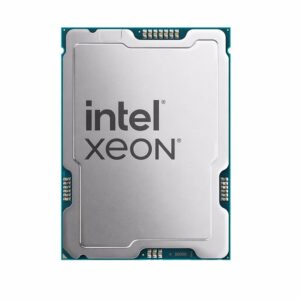
Intel Xeon Gold 5120 Processor (2.2 GHz, 14C, 19.25MB Cache)
Intel Xeon Gold 5120 Processor (2.2 GHz, 14C, 19.25MB Cache)
Reviews
There are no reviews yet.