
24/7 Support Centerinfo@sunspike.net
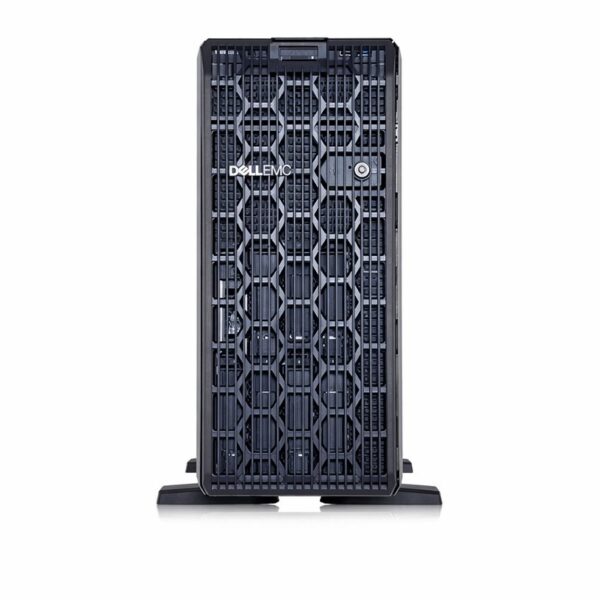
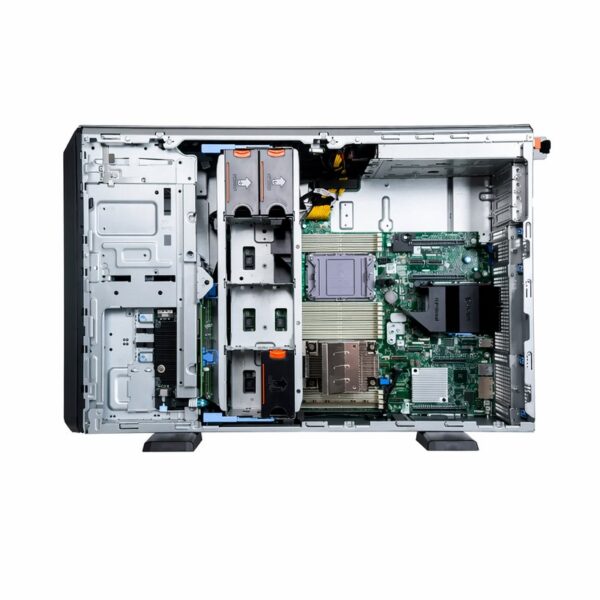
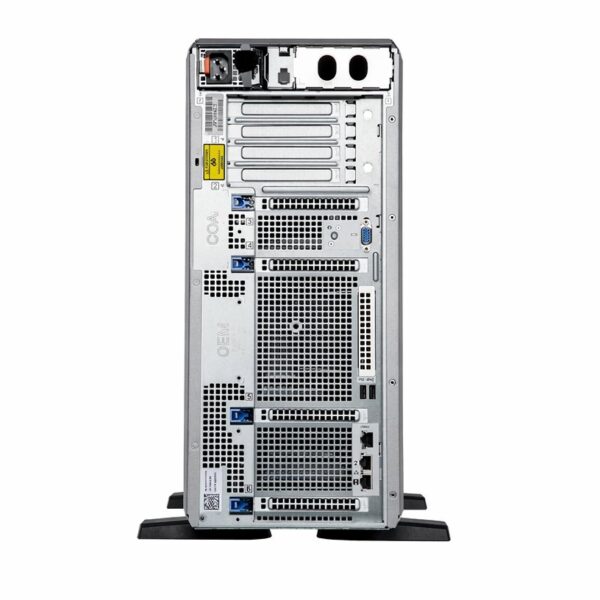
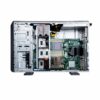
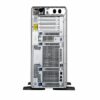
Dell PowerEdge T550 Tower Server
Dell PowerEdge T550 Tower Server
Enterprise stock · tested · export documentation available
Dell PowerEdge T550 — Technical Specifications & Product Overview
1. System Architecture & Processing
-
Form Factor: 5U tower or rack-mountable layout (using an optional rack mount kit).
-
Processor Support: Up to two 3rd Generation Intel® Xeon® Scalable Processors (Ice Lake), up to 32 cores per processor.
-
Processor Interconnect: 3 UPI (Ultra Path Interconnect) links per CPU up to 11.2 GT/s.
-
Thermal Design Power (TDP): Supports up to 220W per processor.
2. Memory Subsystem
-
DIMM Slots: 16 DDR4 DIMM slots (8 slots per processor).
-
Memory Architecture: 8-channel memory per CPU (1 DIMM per channel).
-
Supported RAM Types: Registered DIMMs (RDIMMs) and Load-Reduced DIMMs (LRDIMMs).
-
Maximum Capacity: Up to 1.0 TB using 64GB RDIMMs.
-
Maximum Speed: Up to 3200 MT/s (Note: 16G architectures transition to DDR5, but the T550 utilizes optimized DDR4 infrastructure).
-
Advanced Features: Advanced ECC, Memory Optimized, Memory Sparing, Fault Resilient Memory.
3. Storage & Drive Bays
The T550 chassis features standard front hot-plug backplanes rather than the cabled setups seen in lower-tier models:
-
Configuration A: Up to 8 x 2.5-inch hot-swap SAS/SATA/NVMe HDDs/SSDs.
-
Configuration B: Up to 16 x 2.5-inch hot-swap SAS/SATA/NVMe HDDs/SSDs.
-
Configuration C: Up to 24 x 2.5-inch hot-swap SAS/SATA/NVMe HDDs/SSDs.
-
Configuration D: Up to 8 x 3.5-inch hot-swap SAS/SATA HDDs/SSDs.
4. Storage Controllers & Internal Boot
-
Internal Hardware RAID: PERC H345, PERC H745, PERC H755, PERC H755N (NVMe optimized).
-
External HBAs: HBA355e.
-
Software RAID: Intel Embedded Software RAID S150.
-
Internal Dedicated Boot: BOSS-S2 (Boot Optimized Storage Subsystem), providing hardware RAID via hot-swappable 2 x M.2 SATA SSDs accessible from the rear pane.
5. Expansion I/O Slots (PCIe Layout)
Provides up to 5 PCIe Gen4 slots for low-latency adapter throughput:
-
Slot 1: Full-Height, Full-Length (FH/FL) PCIe Gen4 x16 (from CPU1).
-
Slot 2: FH/FL PCIe Gen4 x8 (x16 physical connector, from CPU2).
-
Slot 3: FH/FL PCIe Gen4 x16 (from CPU2).
-
Slot 4: FH/FL PCIe Gen4 x16 (from CPU1).
-
Slot 5: FH/FL PCIe Gen4 x8 (x16 physical connector, from CPU2).
6. Accelerator Support (GPU)
-
Supports up to 2 x double-width 300W accelerators or 5 x single-width 700W/similar accelerators (e.g., NVIDIA A2, A30, or A40 depending on thermal qualification layout).
-
Requirement: Requires a dual-processor configuration and high-performance cooling fan configurations.
7. Networking, Ports & Connectivity
-
Embedded Network Interfaces: 2 x 1GbE LOM ports on board.
-
OCP Options: 1 x OCP 3.0 mezzanine slot (supports x8 PCIe Gen4 lane bandwidth adapters for 10GbE/256GbE setups).
-
Front Ports: 1 x Dedicated iDRAC Direct (Micro-AB USB), 1 x USB 2.0, 1 x USB 3.0.
-
Rear Ports: 1 x Dedicated iDRAC RJ-45, 1 x Serial DB9, 1 x VGA port, 1 x USB 2.0, 1 x USB 3.0.
8. Embedded Management & Hardware Security
-
Management Architecture: iDRAC9 (Integrated Dell Remote Access Controller 9) infrastructure (Express, Enterprise, or Datacenter options).
-
Security Core: Digitally signed firmware, Silicon Root of Trust, Secure Boot, System Lockdown mode, Secure Erase, TPM 2.0 module.
9. Power Supply Units (PSU)
-
800W Platinum (100-240V AC or 240V HVDC), hot-plug redundant.
-
1100W Titanium (100-240V AC or 240V HVDC), hot-plug redundant.
-
1400W Platinum (100-240V AC or 240V HVDC), hot-plug redundant.
-
2400W Platinum (100-240V AC or 240V HVDC), hot-plug redundant.
Related products
-
Intel® Xeon® Processor E5-2660 v4 (35M Cache, 2.00 GHz)
Intel® Xeon® Processor E5-2660 v4 (35M Cache, 2.00 GHz)
-
Intel Xeon E5-2630 v4 Processor (2.2 GHz, 10C, 25MB Cache)
Intel Xeon E5-2630 v4 Processor (2.2 GHz, 10C, 25MB Cache)
-
Intel® Xeon® Processor E5-2620 v3 15M Cache, 2.40 GHz
Intel® Xeon® Processor E5-2620 v3 15M Cache, 2.40 GHz
-
Intel® Xeon® Processor E5-2690 v3 (30M Cache, 12Core 2.60 GHz)
Intel® Xeon® Processor E5-2690 v3 (30M Cache, 12Core 2.60 GHz)
Reviews
There are no reviews yet.